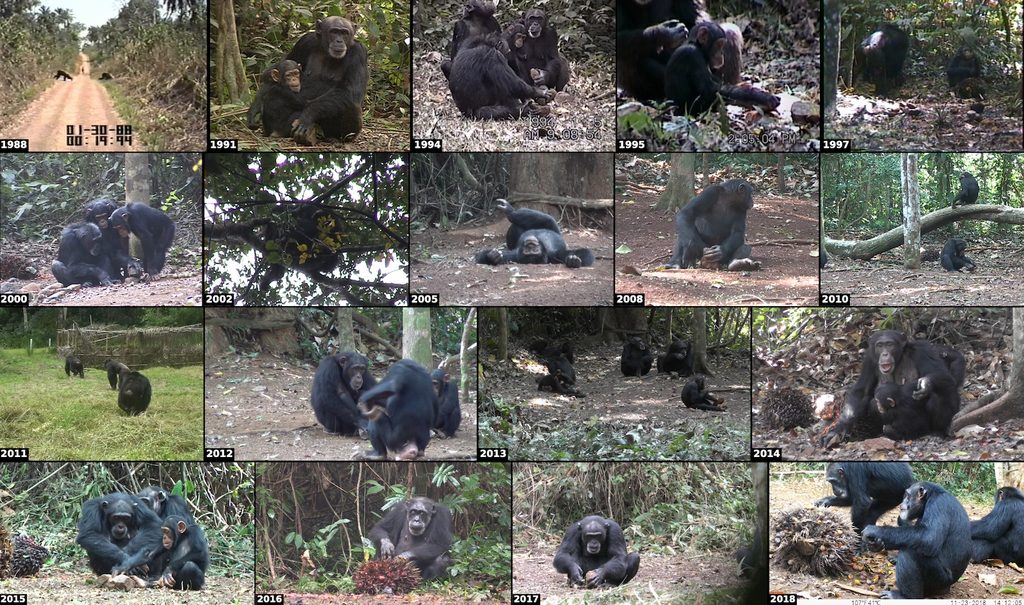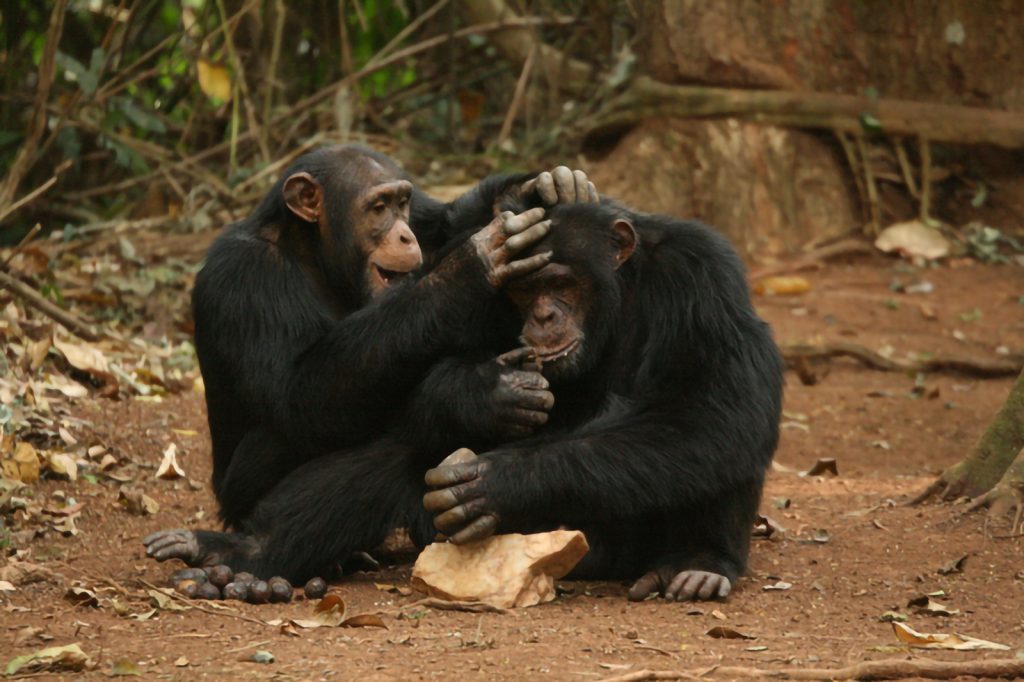
How do chimpanzees learn, interact, use tools, and adapt their behaviour over time? Answering these questions requires more than isolated observations. It requires long-term records that connect individual behaviour to social relationships, ecological conditions, and the histories of individual animals. The Bossou Long-Term Chimpanzee Video Archive is an exceptional resource for this kind of research. Recorded between 1988 and 2018 at Bossou, Guinea, the archive brings together more than 1,200 hours of video documenting wild chimpanzees in an outdoor research setting. It preserves a remarkable record of chimpanzee behaviour and provides new opportunities to investigate animal cognition, sociality, and behavioural variation using modern computational approaches.
Researchers at paleo.group, contribute to this international research effort in collaboration with the Visual Geometry Group (VGG) at the University of Oxford, alongside colleagues at Kyoto University and other partner institutions. Together, this work connects long-term field research with advances in computer vision and machine learning to help unlock the scientific potential of extensive wildlife video archives.
From decades of field research to a new generation of data
The Bossou chimpanzee research project has a long history of investigating wild chimpanzee behaviour, including tool use and nut cracking. Initiated in 1976, the longitudinal field study has generated an exceptional body of knowledge about the community and its behavioural traditions.
The video archive extends this scientific legacy by preserving observations across multiple decades. Rather than treating each recording as an isolated event, researchers can use video to study recurring behaviours, compare individuals, and investigate how behaviour varies across time and context.
In October 2026, the paper BossouChimpanzee: Long-term Chimpanzee Video Dataset introduced the archive and described an initial annotated release, BossouChimpanzee70h. This first release provides a curated entry point into a much larger resource, supporting the development and evaluation of methods for studying individual animals and their behaviour in real-world conditions.
The public dataset at a glance
- More than 1,200 hours of video in the wider archive, spanning 1988–2018.
- 73.95 hours in the initial curated release, comprising 226 video files.
- Six field seasons represented in the current release: 2000, 2004, 2006, 2008, 2012, and 2013.
- 23 identified chimpanzees represented in the released dataset.
- Millions of annotated observations, including face detections and tracks, individual identities, body detections and tracks, and selected tool-use actions.
The released dataset provides a substantial resource for developing reproducible approaches to analysing animal behaviour in naturalistic and semi-naturalistic settings.
Access the dataset and publication
The initial public release, accompanying annotations, and information about the wider archive are available through the Visual Geometry Group at the University of Oxford.
- Explore the dataset: https://robots.ox.ac.uk/~vgg/data/BossouChimpanzee/
- Read the research paper: https://arxiv.org/abs/2610.05293
Researchers interested in using the resource should consult the official dataset documentation and licence for access conditions, citation requirements, and permitted uses.